
Apple Valley City Directory Holdings
The strongest documented Apple Valley city directory route is the Minnesota Historical Society’s Dakota County telephone-directory finding aid. Its collection begins in 1928 and the abstract describes about 1,237 print volumes and 226 fiche. White pages record residential and business names, telephone numbers, and street addresses. Yellow pages organize businesses by subject. For Apple Valley, the finding aid has verified print and yellow-page entries from 1969 through 1981. Those are shelf and item entries, not proof of a complete annual run or online scans. Use the city, year, and shelf notation when asking staff to confirm that a physical item is available.
| Collection | Years | Where Held | Access |
|---|---|---|---|
| MNHS Dakota County telephone-directory finding aid | Collection begins 1928; Apple Valley verified entries 1969–1981 | Minnesota Historical Society, Gale Family Library | Finding aid, reading-room confirmation, or staff request |
| MNHS directory or telephone-book search | Up to five requested years for one name or business | Minnesota Historical Society research service | Paid search with scans or digital delivery when available |
| Dakota County Historical Society archives | Coverage depends on the requested local material | DCHS print, microfilm, and online archives | Catalog and research-service route |
| Dakota County Tribune | 1912 onward | MNHS newspaper route and Gale Family Library | Issue-image research; not every title or year is online |
| Federal census schedules | 1850–1950 public range | National Archives and research libraries | Released schedules, with the 1890 census mostly unavailable |
The MNHS Dakota County telephone-directory finding aid shows the Apple Valley shelf-level path used to locate these materials.
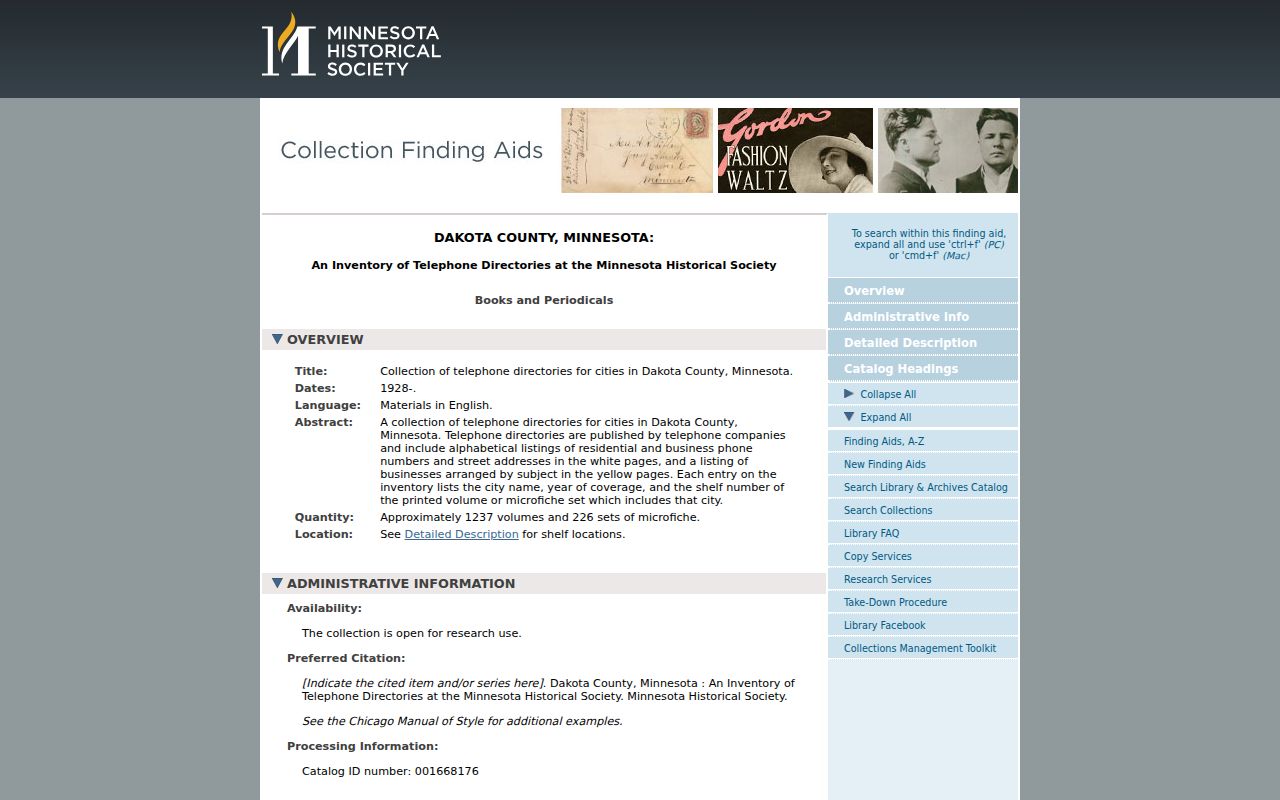
The capture supports a careful request for a particular year and item, rather than a claim that every Apple Valley telephone book is digitized or that each year has one volume.
Request an Apple Valley City Directory
MNHS research services can search city directories and telephone books, newspapers and microfilm, manuscripts, county atlases, and state archives. Its directory-search request allows one individual or business in as many as five years for one city. Select directory, telephone book, or both, then provide the name, city or town, the requested years, and useful extra information. At inspection, the fee was $10 for a directory or telephone book search and $20 for both. The price includes a nonrefundable $5 processing component. Scans or digital delivery may be provided, and the stated turnaround is three to four weeks, with up to 12 weeks possible.
The service warns that directories generally list heads of household. Minors are not listed, and women may appear only when independently entered. An absence can be meaningful, but it is not proof that someone was not present in Apple Valley. Staff may copy a page to document a negative result when no listing is found. Check the holding first, especially where the finding aid has more than one item in a single year.
The MNHS city-directory search request displays the service form and an example directory page used to explain the search process.
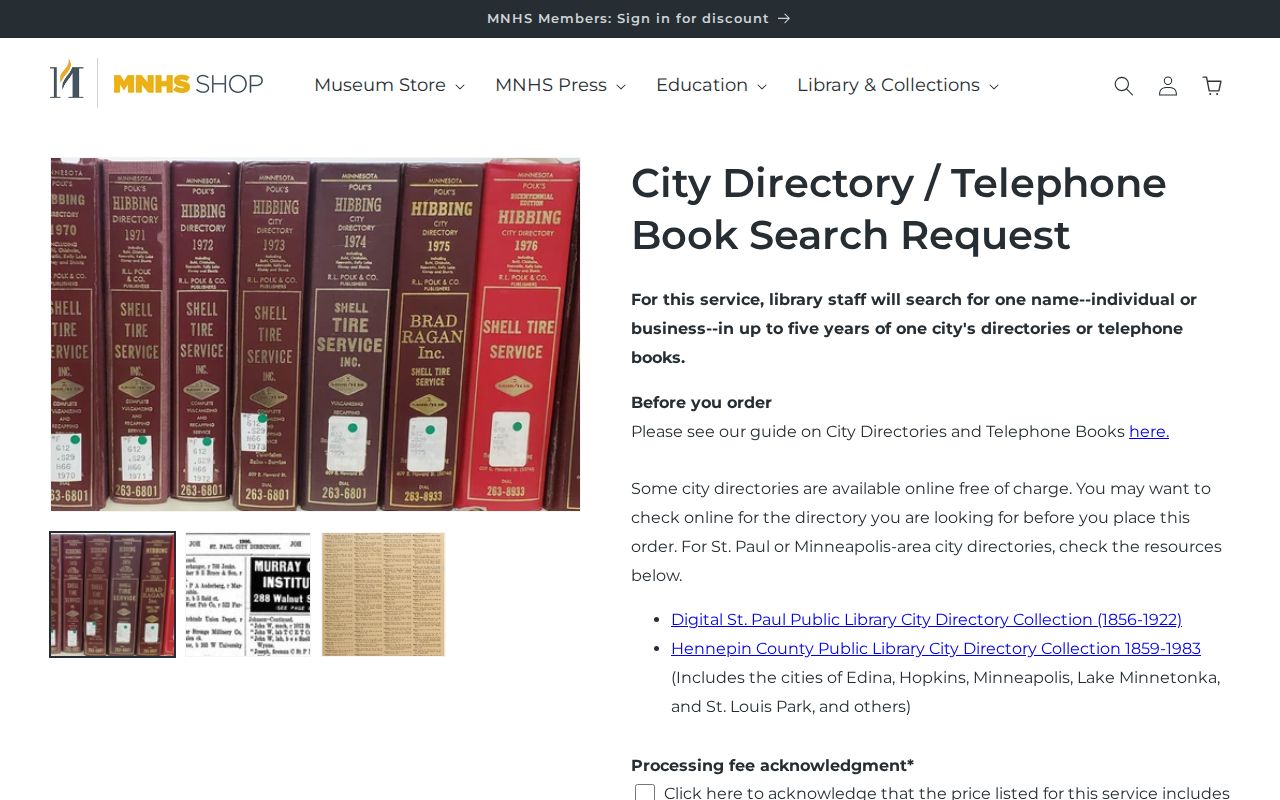
The visible sample is from St. Paul, not Apple Valley, so it is useful for recognizing an entry format but not for asserting an Apple Valley transcription.
Note: Request fees, delivery options, and turnaround periods can change, so confirm the current MNHS form before ordering a search.
Read Apple Valley City Directory Entries
An entry in a historical city directory is evidence that a name was printed in that edition. The MNHS sample and service description support a modest inventory: a surname and given-name line, street address, telephone number where printed, directory section or page, and possible household or business heading. Yellow-page material can add an advertisement or subject classification. It does not confirm every resident of an address, the exact day a household arrived, or a current address. Record the edition year and page beside every transcription, then preserve the wording exactly enough to find the entry again.
- Name line: the name printed under the edition’s indexing practice.
- Address: the residential or business street address shown in that volume.
- Telephone: a number only when the edition includes one.
- Section or page: the white-page, yellow-page, or other location of the entry.
- Heading: a household or business context where the volume supplies one.
- White pages
- The alphabetical residential and business name portion described in the MNHS collection abstract.
- Yellow pages
- The subject or business-listing portion of a telephone directory.
- Householder convention
- A listing pattern that usually favors the head of household and can leave other household members unlisted.
- Finding aid
- An item and shelf locator that helps identify material; it is not itself a scanned city directory.
Trace Apple Valley City Directories
Use a city directory as one dated observation in a household trail. Begin with the first verified Apple Valley entry available for the name, then work across later editions without assuming a missing year means a missing household. Pair the telephone-book sequence with federal census schedules, which are public from 1850 through 1950 under the 72-year release rule. Depending on the census year, schedules can show names, ages, birthplace, immigration or citizenship details, street address, marriage information, occupation, and home value. The 1890 census is mostly lost after a Commerce Department fire, so it cannot serve as a routine bridge.
- Search the MNHS finding aid for the relevant Apple Valley year and note the shelf or item identifier.
- Request or consult the volume, then transcribe the name, address, telephone detail, and page or section.
- Check another verified year for the same spelling and address, noting that several editions or holding locations can exist.
- Match the dated address or household with an available census schedule, using Lebanon Township when the event predates Apple Valley.
- Use newspaper notices, an obituary route, or county property records to test a move, death, or ownership change.
A disappearance can reflect a move, a different listing convention, an unlisted household member, or a gap in the surviving material. It should prompt another record check, not a conclusion by itself. Census research and historic subscriber research can also help separate a property owner from a person who was actually reported at the address.
Note: The census offers dated household evidence, while a telephone listing documents a printed subscriber or business entry for one edition.
Apple Valley City Directory Timeline
Jurisdiction names shape an Apple Valley city directory search. The area first appears in records as Lebanon Township. The 1968 vote created the Town or Village of Apple Valley context, officials began on January 1, 1969, and statutory-city records begin on January 1, 1974. That sequence overlaps the verified Apple Valley telephone-book entries. It also explains why older census, naturalization, cemetery, map, and property material may be filed under Lebanon rather than a modern city label.
- Before 1969: search Lebanon Township or Town of Lebanon alongside a name or address.
- 1969: village officials began, and the MNHS finding aid shows the first verified Apple Valley telephone-directory entries.
- 1974: Apple Valley statutory-city records begin.
- 1969–1981: the verified MNHS Apple Valley finding-aid entries provide the documented telephone-book span.
Modern municipal minutes are available through the city’s Laserfiche archive path, but county deeds, tax rolls, courts, and vital records can predate incorporation. Search the jurisdiction that existed when the event occurred.
Apple Valley Directory Research Desks
The Dakota County Library system offers catalog access and A–Z research tools across 10 branches. Galaxie Library is the Apple Valley branch, but the published address needs care: a city resource page gives 14955 Galaxie Avenue, while inspected Minnesota State Library annual reports for 2021, 2023, and 2024 give 14355 Galaxie Avenue. Call 952-891-7045 before traveling. The county library system’s main phone is 651-450-2900 and its research contact is askalibrarian@co.dakota.mn.us.
Dakota County Historical Society maintains print, microfilm, and online archives and describes more than half a million church, cemetery, and census-related records. Its research service can assist with obituaries, marriage announcements, Catholic church records, and other local material for a listed donation-based rate of $15 per half hour. Lawshe Memorial Museum is at 130 3rd Avenue North, South St. Paul, MN 55075, and its phone is 651-552-7548.
These are complementary routes. MNHS holds the verified telephone-directory path, while DCHS can add local context that a directory does not show.
Note: The Galaxie Library address conflict is unresolved in the inspected sources, so telephone confirmation should come before an in-person visit.
Apple Valley Tribune Directory Trail
The Dakota County Tribune route adds public notices, obituaries, school and church activity, and subdivision or development reporting to a city directory trail. The paper began in Farmington in February 1912, later served Burnsville, and continues publication. MNHS identifies Gale Family Library in St. Paul as an access route. The Minnesota Digital Newspaper Hub contains millions of pages, but it does not place every title and year online.
Search a name with a street, church, school, or subdivision term, then verify a promising result against the issue image. Newspaper items are especially useful when a telephone entry drops out between years, because they can supply a dated event without turning the entry into proof of occupancy.
Apple Valley Directory Research Numbers
When a telephone-book search reaches a dead end, the Dakota County Historical Society’s 1918 registration index provides a different kind of dated name clue. The index shows 259 paginated pages and records a microfilm-roll field with each result. Its displayed fields include last and first name, birthplace, age, residence, and city. It is not an Apple Valley city directory, but it can help identify a person or place to test against the correct directory year, census schedule, or newspaper issue.
Record the roll number from the index rather than relying on the web row alone. DCHS maintains print, microfilm, and online archives, so the roll can guide a request for the fuller historical record. This measured handoff preserves the difference between a registration entry, a telephone subscriber listing, and a documented household observation.
Apple Valley City Directory Gaps
No verified Apple Valley Polk city-directory series, reverse or criss-cross directory run, publisher name, or complete post-1981 run was located in the official sources reviewed. The MNHS items should therefore be called telephone-directory holdings, not Polk directories. They should also not be treated as a complete digital collection. Ask MNHS staff about a specific city, year, and shelf reference, and use other records when the desired period falls outside the verified entries.
Older material can require Lebanon Township, Town of Lebanon, Village of Apple Valley, or City of Apple Valley as the jurisdiction term. For naturalization, the National Archives notes that any court of record could handle a case before September 27, 1906, so Minnesota records may sit in federal regional holdings, state or county courts, or local historical collections. Alternate spelling and historical jurisdiction searches are better than filling a gap with assumptions.
Apple Valley Cemetery Records
Lebanon Cemetery offers a separate historical marker for Apple Valley research. Its earliest recorded burial was May 25, 1861, long before the modern city existed. That fact does not turn the cemetery into a public resident directory, and no official public name search was located. City or cemetery records remain the appropriate route for burial or lot history. For a family trail, use a directory entry as one date, then compare it with census, newspaper, church, cemetery, and property evidence.
The contrast matters: people can appear in historical records before the municipal name appears. A city directory search that begins only with Apple Valley can miss the Lebanon-era documentation that gives the household its earlier context.